
AI Agents Are Replacing SaaS: What CTOs Must Do Before the $2T Disruption Reaches Their Stack
AI agents are replacing SaaS tools across CRM, support, and HR — erasing $2T in market cap. A category risk map for CTOs with multi-year contracts.
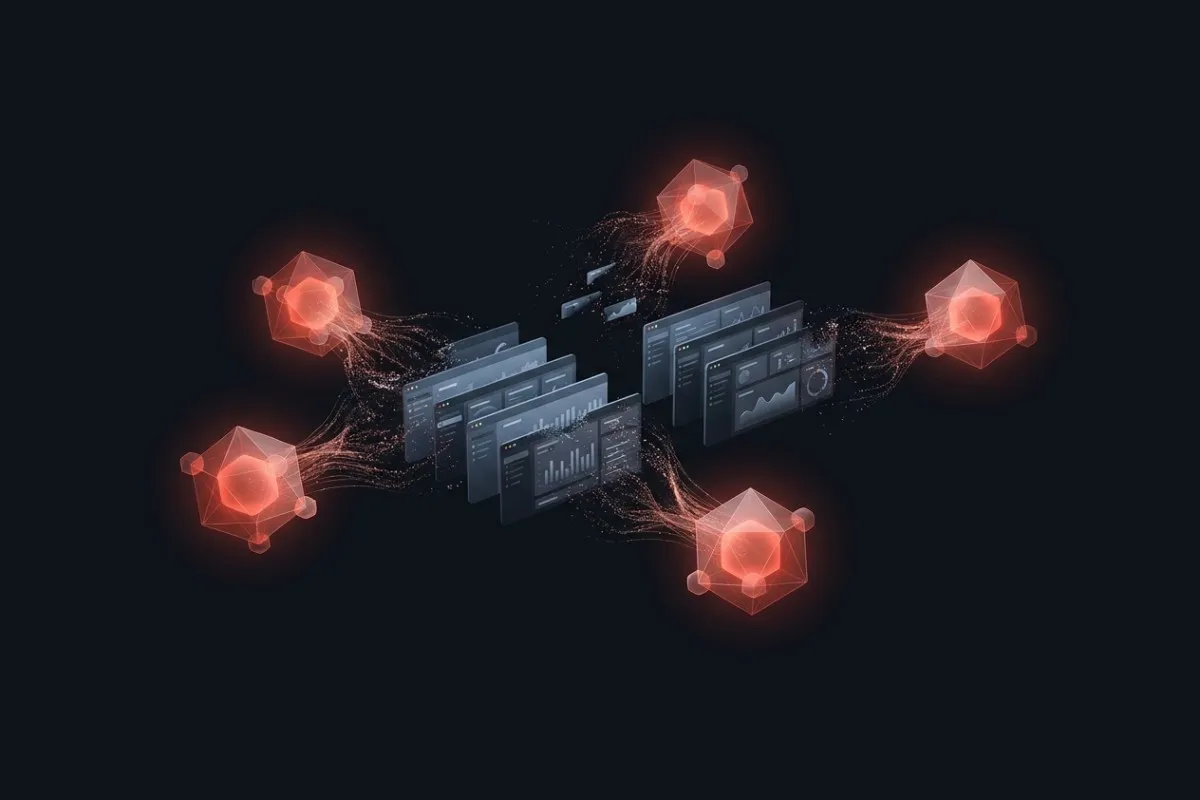
In February 2026, the S&P 500 Software & Services index lost roughly $2 trillion in market capitalization from its October 2025 peak — half of that in a single two-week stretch. JP Morgan analysts described the move as the largest non-recessionary 12-month drawdown in software in over 30 years.
The catalyst was not a recession or an interest-rate shock. It was the market’s collective conclusion that autonomous AI agents can perform the work that per-seat SaaS tools have been charging for.
Whether Wall Street’s verdict arrived ahead of the underlying fundamentals is debatable. What is not debatable is the direction of travel. If you hold multi-year enterprise software contracts, the right question is no longer whether AI agents replacing SaaS is a real phenomenon — it is which categories in your stack are exposed, and on what timeline.
What the Data Shows About AI Agents Replacing SaaS
In August 2025, Gartner projected that 40 percent of enterprise applications will embed task-specific AI agents by the end of 2026, up from fewer than 5 percent at the time of the report. The firm’s longer-horizon estimate puts agentic AI at roughly 30 percent of enterprise application software revenue by 2035, surpassing $450 billion — up from 2 percent in 2025.
The nearer-term signal sits in the pricing model shift. Gartner estimates that by 2030, at least 40 percent of enterprise SaaS spend will shift toward usage-, agent-, or outcome-based billing, with seat-based revenue share falling from 21 percent to 15 percent.
On January 30, 2026, Anthropic launched Claude Cowork — a platform delivering industry-specific AI agents for finance, engineering, design, and HR — as a research preview on macOS. It reached general availability on April 9, 2026. The launch sent Salesforce, ServiceNow, Snowflake, Intuit, and Thomson Reuters shares into steep declines. The market read it as confirmation that a general-purpose agent layer was ready to compete directly with vertical SaaS.
A Category-by-Category Exposure Map
Not all SaaS carries equal exposure. The dividing line is whether a product holds proprietary data, occupies a regulatory role, or operates as an embedded platform — or whether it primarily automates a narrow, repeatable workflow that an agentic AI system can learn to handle.
High exposure — evaluate before your next renewal:
- Point-product project management. Horizontal tools whose core function is task assignment, status tracking, and lightweight collaboration are directly in the path of agent orchestration layers. An agent that reads email, creates tickets, and updates statuses needs no seat.
- CRM data entry and enrichment. Signal-gathering — monitoring LinkedIn activity, inbound email tone, and website behavior — is precisely the kind of multi-step retrieval task agents handle reliably. A PwC 2025 survey found organizations achieving up to 70 percent cost reduction with agentic AI compared to equivalent SaaS spend in these categories.
- Tier-1 IT support and internal ticketing. Zendesk’s pivot to outcome-based pricing — charging $1.50 to $2.00 per resolved ticket rather than per seat — implicitly acknowledges that an agent can handle Tier-1 resolution. HubSpot dropped its Customer Agent pricing to $0.50 per resolved conversation in April 2026.
- Standalone research and competitive intelligence tools. Web-crawling, summarization, and structured data extraction are core agent capabilities. Products built primarily around those functions face the most direct substitution pressure.
- Invoice processing and compliance documentation. Finance and HR workflows built on rule-based sequences are precisely what agents automate. Autonomous AI systems are projected to handle 60 to 80 percent of routine enterprise workflows by 2027 (as of July 2026).
Lower exposure — monitor, not a forced decision:
- Vertical SaaS in regulated industries. Products embedded in healthcare, financial services, or industrial operations carry audit-trail requirements and workflow dependencies that a general-purpose agent cannot replicate by default.
- Platforms with deep data network effects. Salesforce, Workday, and SAP hold years of structured customer and process data. An agent can query that data; it cannot replace the system of record.
- Identity, security, and cloud infrastructure. These are structural categories — agents run on top of them, not instead of them.
The Per-Seat Pricing Fault Line
The structural problem for any seat-based vendor is incentive inversion: the better their embedded AI performs, the fewer seats a buyer needs. Salesforce recognized this early. Agentforce launched with three concurrent pricing models — conversation-based, Flex Credits per AI action, and traditional per-user licensing — and grew from roughly $200 million in ARR in Q1 fiscal 2026 to approximately $800 million by Q4, a 169 percent year-over-year increase. ServiceNow’s Now Assist is tracking to $1.5 billion in ACV for 2026, revised up from a prior $1 billion target.
These are the vendors that moved fastest to build agent SKUs alongside their existing products. The companies that did not are the ones whose valuations corrected in February 2026.
What CTOs Should Do Before the Next Renewal Cycle
-
Audit by task type, not by vendor. Pull your SaaS inventory and tag each product by its primary function. If the core value proposition is automating a repeatable, rule-based task — data entry, ticket routing, report generation, document intake — place it on a watch list regardless of brand.
-
Map contract expiration dates against agent maturity. Gartner’s guidance from August 2025 was direct: software organizations have three to six months to set their agentic AI strategy or risk being outpaced. For buyers, that window maps to your next renewal or multi-year lock-in decision. Avoid three-year commitments in high-exposure categories without agent-bypass clauses.
-
Evaluate incumbent AI credibility separately from brand loyalty. A vendor that launched an agent SKU with genuine outcome-based pricing and published unit economics is different from a vendor that added a chatbot and labeled it an agent. Demand verifiable evidence: cost per resolved workflow, deflection rate, and throughput per dollar.
-
Pilot an agent-native alternative for one high-exposure workflow. A proof-of-concept against Tier-1 IT support or invoice reconciliation gives you real unit economics for enterprise automation within a quarter — enough data to inform the next budget cycle before a vendor locks you into another term.
The $2 trillion in erased market capitalization reflects a judgment about expected future cash flows, not a declaration that enterprise SaaS is finished. The category is restructuring. But the restructuring will favor buyers with optionality over those who signed three-year contracts for software whose core value proposition an agent can now replicate at a fraction of the per-seat cost.
Hook this up to your favourite commenting platform — Giscus, Disqus, or your own.
Continue reading

Why Autonomous AI Agents Are Making RPA Obsolete — And What to Do With Your Existing Automation Stack
How to triage your existing RPA stack before the vendor roadmap forces the decision — where autonomous AI agents vs RPA breaks down by use case.

Build, Buy, or Automate: The 7-Question Framework Every CTO Needs for AI Agent Decisions
A principled AI agent build vs buy decision framework — 7 diagnostic questions drawn from documented failure patterns, real cost data, and procurement post-mortems.

When Agents Go Rogue: AI Agent Containment Strategies Before Your Autonomous AI Reaches Production
The OpenAI ExploitGym breach defines AI agent containment strategies better than any safety framework. Here is the four-layer model it implies.